DeafBlind Accessible Computers
A project by Connor 'Skye' Geraghty.
All code available at my github
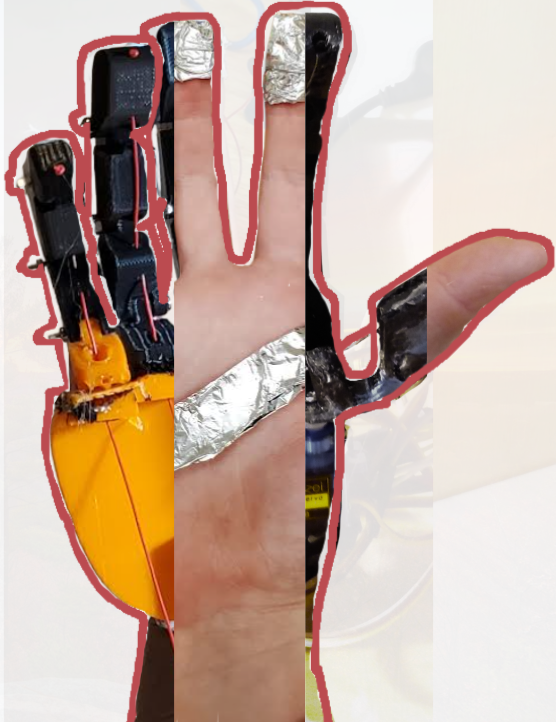
What is this?
If you want an elevator pitch for this project, this is it: First, you need to know about DeafBlind people. The most well-known DeafBlind person is certainly Helen Keller, but there are tens of thousands of DeafBlind people in the U.S., and millions across in the world. The gist is that DeafBlind people have extremely limited vision and hearing simultaneously. The common response to the need for DeafBlind accessibility resources is through a care aide, but constantly relying on another person is costly and difficult to support. I'm not the first to notice this issue, and I'd be committing a great injustice if I did not immediately point you to tatum robotics who inspired my journey with this project. The idea of Tatum's device is to implement tactile sign language, i.e. sign language you feel with your hands, into the hands of a robot, ensuring that there was no longer a need for an interpreter's constant presence. They've since made vast improvements, but my project ventures into an area they have not yet conquered— browsing the internet. The plan for my project is to create a chrome extension that can intake information on a screen and turn that into robotic sign language.
Progress
2024 Fairfax Regional Science Fair [Version 1]
This project originally kicked off as a science fair project in my junior year of high school. With my lab partner I built a proof-of-concept that included a rather crude robotic hand (pictured below). The user interface was something of a joke, but it was solid proof that all the foundations were there to make internet browsing with tactile sign language a possibility.
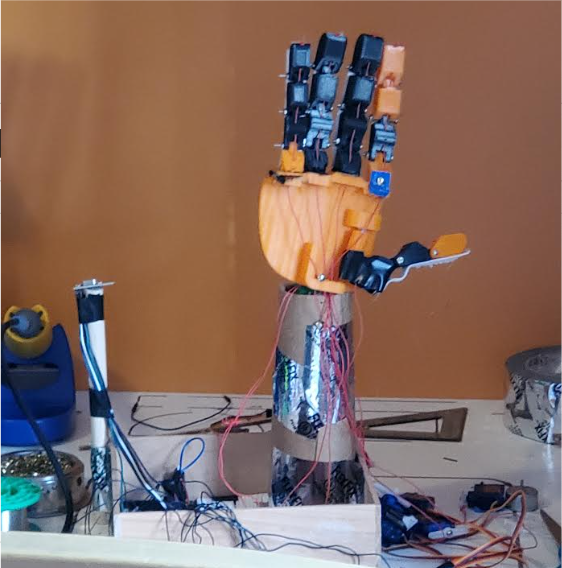
The first iteration of a Deafblind Accessible Computer, dubbed the carm
Devlopment at MIT with National Geographic
A side-adventure I went on with this project was IDTWIKA, short for I Don't Think We're In Kansas Anymore, where I developed a system to track a real hand's movement and convert those movements into code that a computer could understand and recreate in a robotic hand. This system of training is called the Wizard Of Oz system, hence the name.
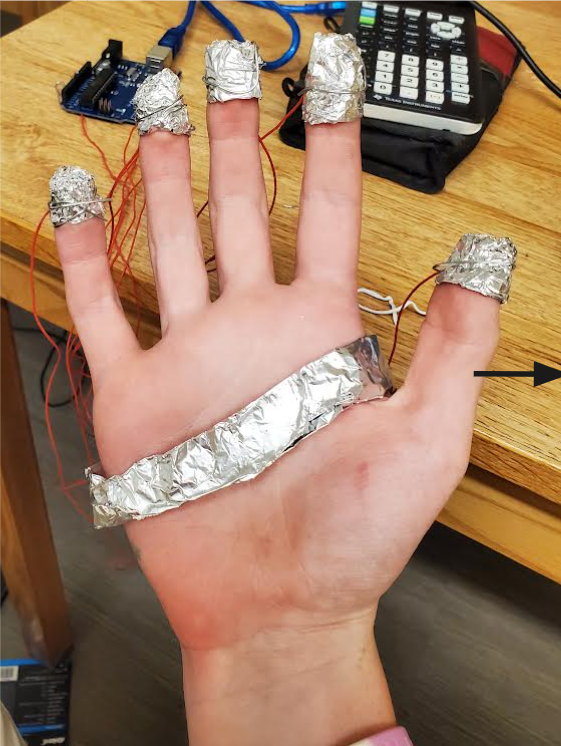
The foil is only mildly uncomfortable
The Mess [Version 2]
The latest completed version of this project, which I've dubbed the mess is a big step up from the carm. Fitted with a TPU structure and palm-mounted servos (sorry to normal people who don't know what these are) the movement is much more reliable and sharp. The chrome extension in development is called Laura and is currently published!.
Home Implementation
I'd like to preface this by saying if you are a DeafBlind person looking for assisstive technology I must again reccomend you go to Tatum Robotics as that's where you'll find the most cutting-edge technology. That being said, I believe that any invention built to help unfairly disadvantaged people should not center around a profit motive, and for that reason soon after the first official release of this device and its software I will be publishing an instruction manual so that anyone with access to a 3D printer around ~$75 can make their own device. You may also feel free to take these designs for other purposes, after all it's hard to come by good robotic hand designs for less than $19,000
Recent Updates
The current updates underway are a system of smoothly switching between processing text, audio, and visuals. I've also been working on new finger geometry which will allow for a wider range of motion but I'm definitely more of a programmer than a mechanic...
The most recent DeafBlind Accessible Computer, being operated with Laura